

Milling, knife cutting, grooving and tapping: what the VERSO VSR and LT cut and machine, material by material.
VERSO CNC machines combine a 9 kW milling spindle (2,000 to 24,000 rpm) and, on the VSR, the UTM (Universal Tangential Module): tangential knife, oscillating knife, V-cut, creasing wheel and tapping. They cut and machine aluminium, PMMA and wood as well as vinyl, cardboard, acoustic felt or rubber.
The LT works with milling cutters only: it covers all rigid materials that can be milled, but not the materials that are cut with a knife.
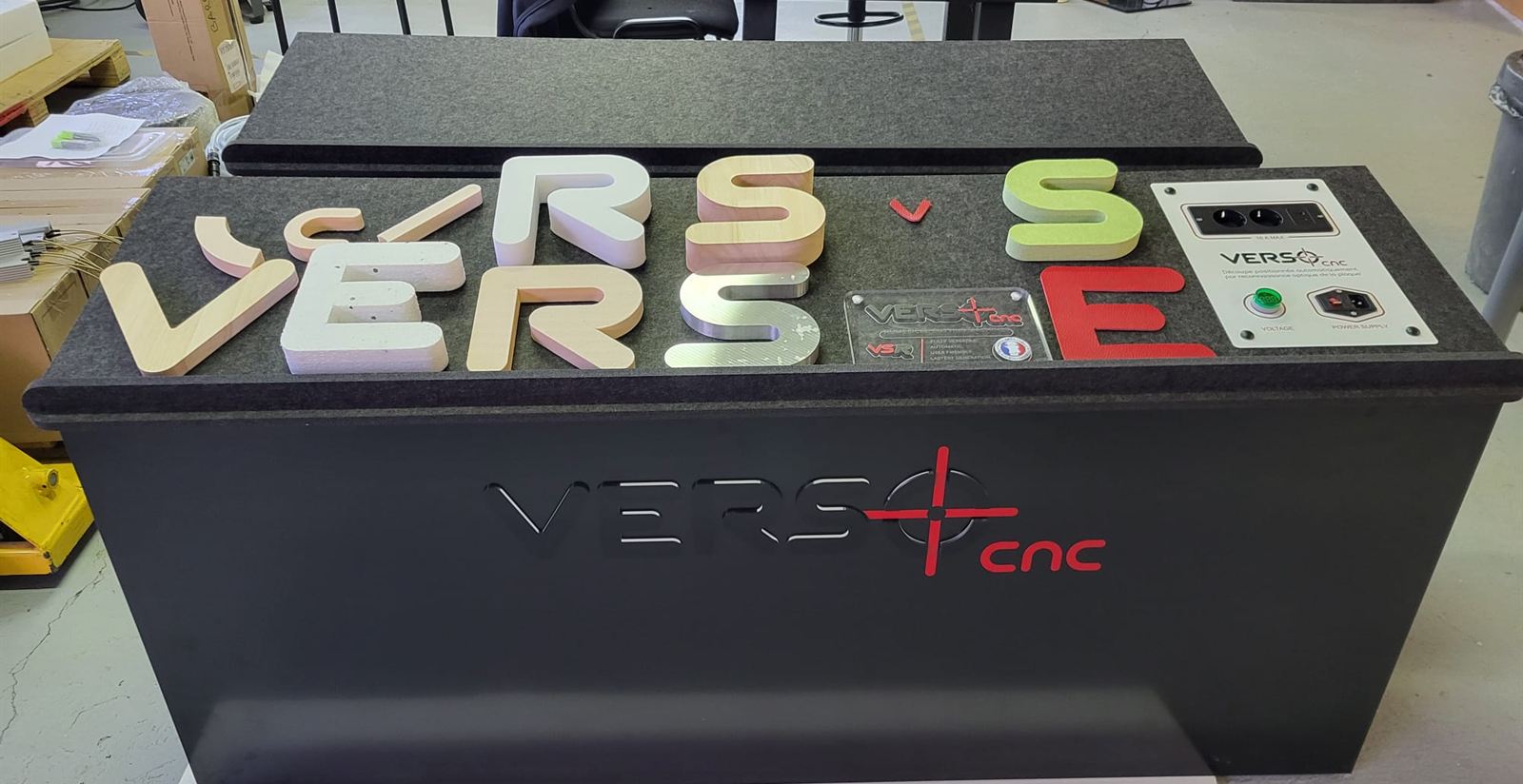
Folded Dibond case, acoustic felt top, wooden structure, PMMA and vinyl logo: every component of this display stand was machined on a VERSO VSR.
| Material | Main method | VSR | LT | Details |
|---|---|---|---|---|
| PMMA (acrylic, Plexiglas) | Single-flute end mill – transparent edges | Yes | Yes (no tapping) | PMMA |
| Polycarbonate | Milling, like PMMA | Yes | Yes | PMMA |
| Bloc-LED | Pockets, shoulders, tapping | Yes | Yes (no tapping) | PMMA |
| Solid aluminium | Coated end mill + air jet | Yes | Yes (no tapping) | Aluminium |
| Copper, brass | Like aluminium | Yes | Yes | Aluminium |
| Aluminium composite (Dibond, Alupanel, Hylite) | Straight end mill + V-groove bit for folding | Yes | Yes | Aluminium composite |
| Solid wood, plywood, MDF, panels | Compression or straight bit | Yes | Yes | Wood |
| Expanded PVC (Forex) | End mill; tangential knife < 5 mm | Yes | Yes (end mill only) | PVC |
| Solid PVC | Coated end mill | Yes | Yes | PVC |
| POM, nylon, PTFE, PE | Single-flute end mill, tapping | Yes | Yes (no tapping) | Engineering plastics |
| Fibreglass, sandwich panels | Suitable end mill (diamond cut) | Yes | Yes | Composites |
| PET acoustic felt | Tangential or oscillating knife, V-cut | Yes | No | Felt |
| Adhesive vinyl, banner, magnetic sheet | Tangential knife | Yes | No | Soft materials |
| Cardboard, foam board | Oscillating knife, creasing wheel, V-cut | Yes | No | Soft materials |
| Corrugated polypropylene (Akylux) | Tangential or oscillating knife | Yes | No | Soft materials |
| Stadur®, Reboard | Oscillating knife + grooving | Yes | No | Soft materials |
| Leather, carpet, textiles | Oscillating knife | Yes | No | Soft materials |
| Polystyrene | Oscillating knife | Yes | No | Soft materials |
| Foams (PE, PU) | Oscillating knife or end mill depending on the foam | Yes | Depending on the foam (end mill) | Soft materials |
| Rubbers | Knife or end mill depending on hardness and thickness | Yes | Depending on hardness (end mill) | Soft materials |
| Floor-marking film | Short carbide blade, warm material | Yes | No | Soft materials |
| Paper | Tangential or oscillating knife | Yes | No | Soft materials |
| Steel, stainless steel, ferrous metals | — | Not allowed | Not allowed | — |
The conventional working limit is 80 mm, on both the VSR and the LT. This is not the clearance under the gantry: the value takes tool clearances and safety margins into account. Going beyond is still possible, but outside conventional use.
No. Steel, stainless steel and all ferrous metals are not allowed. VERSO machines do machine aluminium, copper and brass.
The LT works with milling cutters only: milling, drilling, pocketing and grooving. The VSR adds the UTM (Universal Tangential Module), which provides tangential and oscillating knife cutting, V-cut, creasing wheel and automatic tapping. Soft and semi-rigid materials that are cut with a knife (acoustic felt, vinyl, cardboard, leather, carpet…) are therefore VSR-only.
No. VERSO machines are equipped with a vacuum table and use no cutting fluid. With coated end mills, a compressed-air jet aimed at the cutter is enough for cooling.
No, they are indicative example settings. Optimal values depend on the exact material, the expected result, and the quality and wear of the tool.
Use down-cut cutters (left-hand helix): they compress the chips between the scrap and the part, which holds the part in place until the end of the cut. For example, in 3 mm Dibond, a 3 mm left-hand cutter cuts a 5 mm diameter circle without it moving at the end of the cut. VERSOCAM also includes dedicated functions: on small parts, the machine slows down at the end of the cut and, on the VSR, the turbine boost mode is activated. Tabs are another solution: at the end of cutting, the gantry moves to its park position and VERSOCAM offers to machine the tabs. The operator can then apply simple paper tape to the most sensitive parts; the cutter then removes the tabs at low speed, through the tape, which keeps holding the part.
VERSO does not sell cutting tools: the machines use standard tools that are easy to find from many suppliers. The same goes for ISO30 tool holders and ER32 collets. Only the UTM tool holders are specific to VERSO; they are available from the local distributor or, if needed, from VERSO.
It varies greatly depending on the material. A simple carbide cutter in expanded PVC, even thick, lasts a very long time: several kilometres of cutting. In aluminium composite, too high a cutting speed gives good results at first but quickly damages the cutter, whereas a coated cutter used in the right conditions lasts a very long time. Some materials, such as Trespa®, are very abrasive and require cutters to be changed more often.
Transparent edges without polishing, engraving, tapping, Bloc-LED.
No coolant, coated end mills, tapping up to M10.
Perfect folding grooves, trays, fast cutting.
Species, panels, compression bit, okoumé, rubberwood.
Forex at 60 m/min with a knife, solid PVC without melting.
POM, nylon, PE, PTFE, fibreglass, sandwich panels.
Vinyl, cardboard, foams, leather, rubber, Stadur, Akylux…
Full machine specifications: VSR technical specifications · LT technical specifications.
Contact us for a demonstration or a personalised quote.
Contact us