

Transparent edges straight off the machine, constant-depth engraving, tapping and channel letters: PMMA on the VERSO VSR and LT.
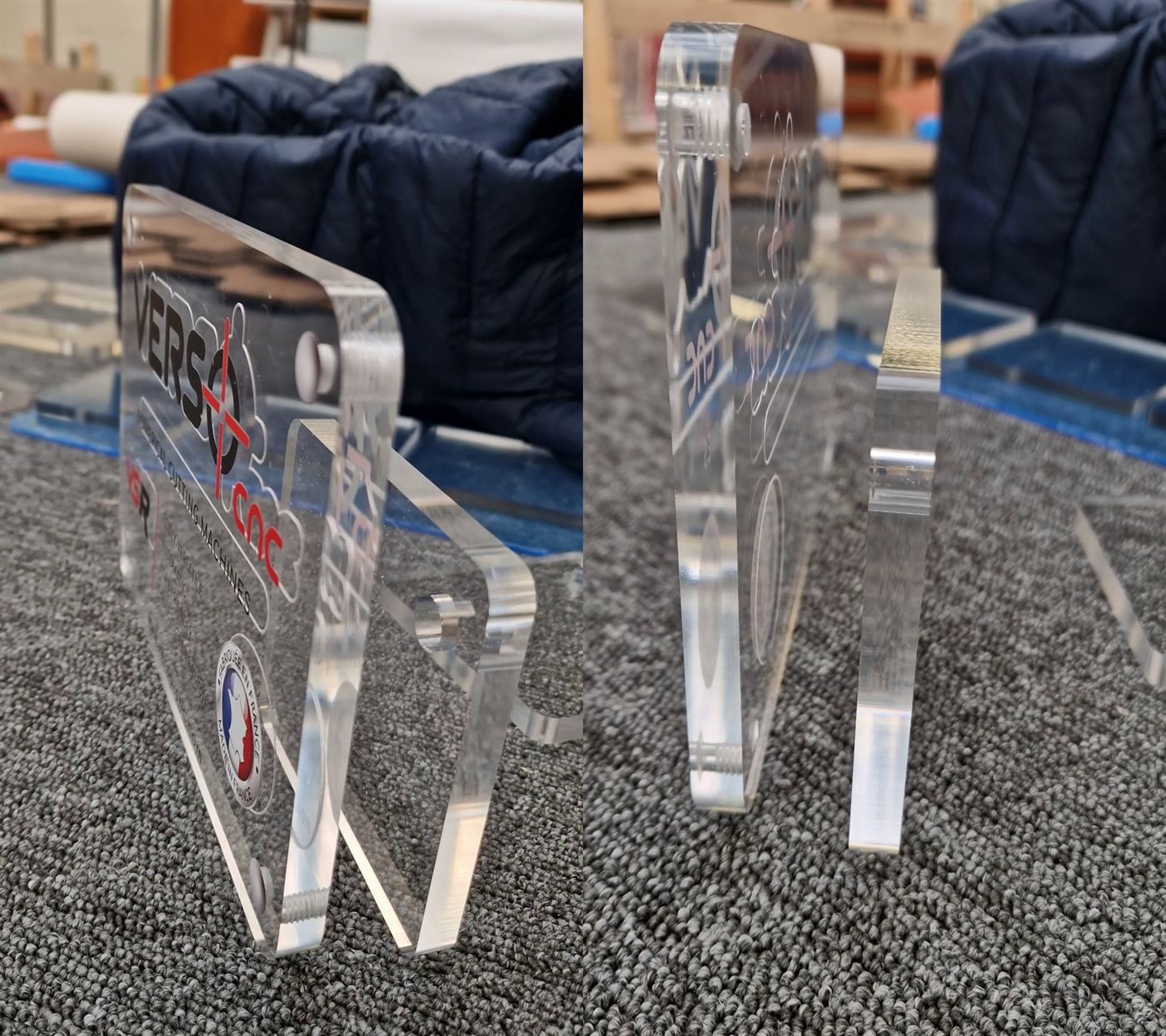
On VERSO machines, cast PMMA comes off the cut with perfectly transparent, glossy edges, without any finishing. The secret: a single-flute carbide end mill with a right-hand helix, a very common and inexpensive tool whose geometry polishes the PMMA as it cuts, combined with a tangential lead-in.
Example: 10 mm cast PMMA, a single pass, about 3,500 mm/min, spindle at 24,000 rpm. The optimal value varies with the brand and composition of the cast PMMA.
| Material | Thickness | Tool | Passes | Feed rate | Spindle |
|---|---|---|---|---|---|
| Cast PMMA | 10 mm | Single-flute carbide end mill, right-hand helix, tangential lead-in | 1 | ≈ 3,500 mm/min | 24,000 rpm |
| Bloc-LED | 30 mm | End mill | 1 | 3,500 mm/min | — |
Indicative values: they depend on the exact material, the expected result, and the quality and wear of the tool. Conventional working thickness of the machines: up to 80 mm.
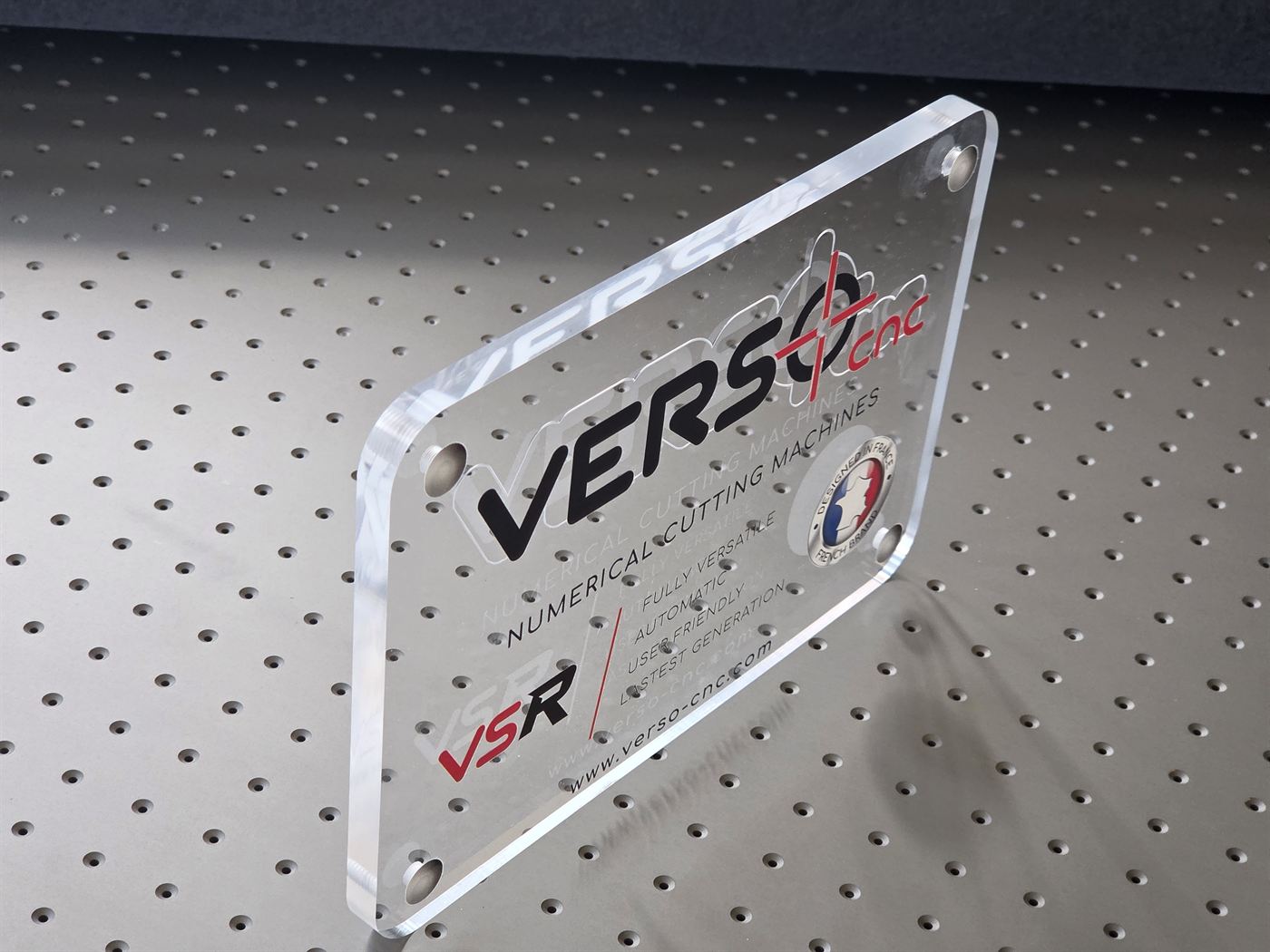
Cast PMMA is very irregular in thickness within a single sheet. The VSR measures the surface geometry before machining and engraves at constant depth: for example a perfectly regular 0.2 mm engraving on a sheet whose thickness varies from 9.52 to 10.44 mm.
This material measurement is specific to the VSR: the LT probe is only used to record the table geometry.
Knife engraving for edge lighting. For very fine engravings intended for edge-lit (tangential) lighting, a carbide blade mounted in the UTM engraves the PMMA to 0.1 to 0.2 mm, much faster than an engraving cutter. An unconventional but simple method, successfully tested by VERSO: any short, slightly thick carbide blade of the type intended for cutting thin plastics will do.
Tapping. In addition to cutting, drilling and pocketing, the VSR taps holes in PMMA thanks to the UTM. The drilling-tapping cycle is automatic and defined in the CAD software.
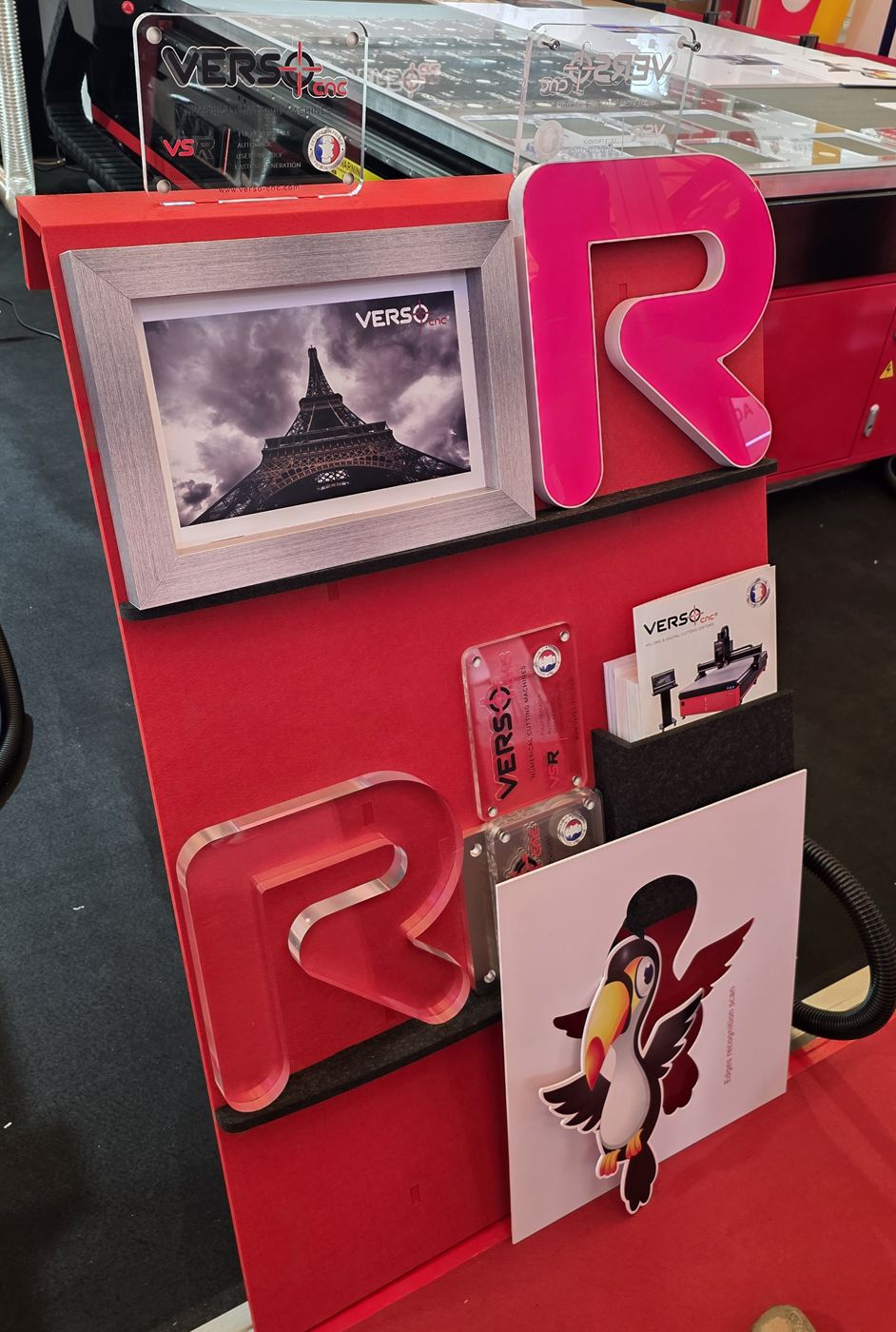
Pockets, shoulders, tapping: the machine performs every operation needed to easily create a channel letter body in Bloc-LED. The pink R on this display – letter and cover – was made with a dedicated VERSOCAM macro.
Published example setting: 30 mm Bloc-LED cut in one pass at 3,500 mm/min.
Polycarbonate machines very much like PMMA, with similar methods and speeds. The only visible difference: its edges are satin and not transparent.
| Operation | VSR | LT |
|---|---|---|
| Cutting, drilling, pocketing | Yes | Yes |
| Constant-depth engraving (material measurement) | Yes | No |
| Knife engraving (UTM) | Yes | No |
| Tapping (UTM) | Yes | No |
With a single-flute carbide end mill with a right-hand helix, a very common and inexpensive tool whose geometry polishes the PMMA as it cuts. Example on a VERSO machine: 10 mm cast PMMA cut in a single pass, feed rate of about 3,500 mm/min, spindle at 24,000 rpm, with tangential lead-in. The edges come out transparent and glossy.
Cast PMMA is the best for machining. VERSO machines also cut extruded PMMA, but with less satisfactory results, which is true of milling in general.
Yes, on the VERSO VSR. Cast PMMA is very irregular in thickness within a single sheet: the VSR measures the surface geometry before machining and engraves at constant depth. Published example: constant 0.2 mm engraving on a sheet measured between 9.52 and 10.44 mm. The LT does not measure the material.
Yes, on the VSR. The UTM module performs drilling and then tapping automatically; the cycle is defined in the CAD software.
Yes, the method and speeds are very close to those of PMMA. However, polycarbonate edges are satin and not transparent.
No coolant, coated end mills, tapping up to M10.
Perfect folding grooves, trays, fast cutting.
Species, panels, compression bit, okoumé, rubberwood.
Forex at 60 m/min with a knife, solid PVC without melting.
POM, nylon, PE, PTFE, fibreglass, sandwich panels.
Vinyl, cardboard, foams, leather, rubber, Stadur, Akylux…
Overview and summary table: all machinable materials.
Full machine specifications: VSR technical specifications · LT technical specifications.
Contact us for a demonstration or a personalised quote.
Contact us